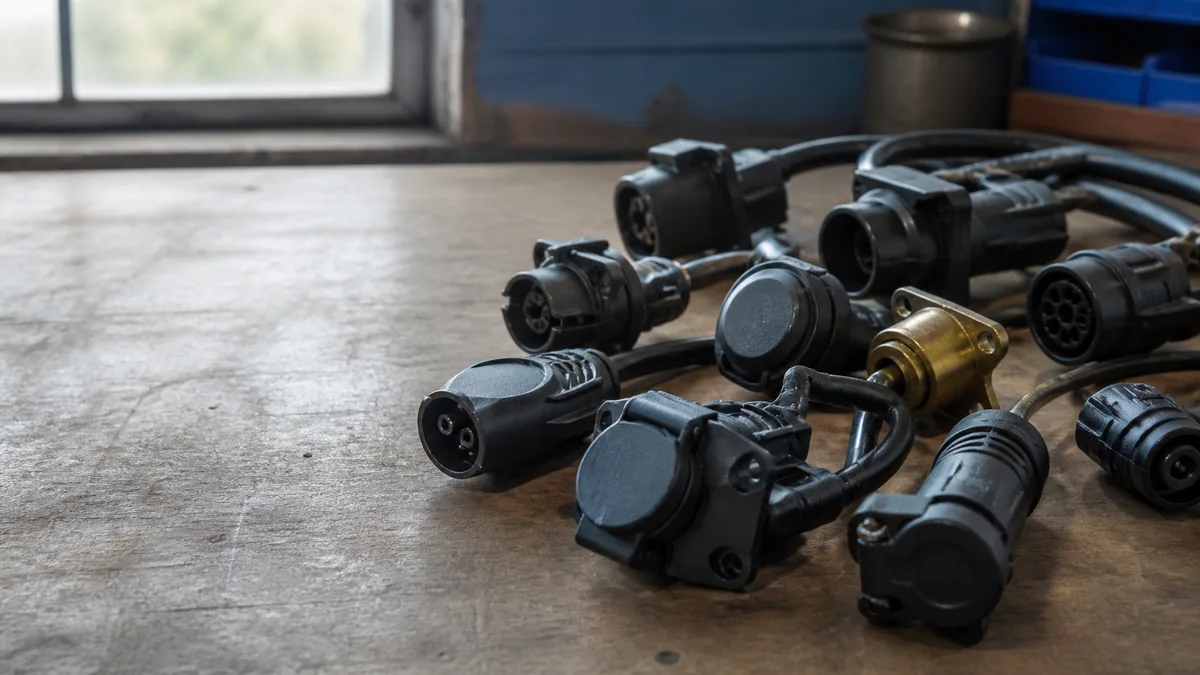
Choose a trailer connector by the independent circuits the trailer needs, not by appearance alone. A connector body provides positions. It does not prove that the tow vehicle supplies each position or that a previous installer followed a familiar color convention.
Identify the connector before counting functions
A 4-way flat normally carries ground, tail/running lamps, left stop/turn, and right stop/turn. A 5-way flat adds one assigned circuit, often reverse or a surge-brake lockout. A 6-way round provides two positions beyond the four base circuits, but its assignments require product-specific verification. A 7-way RV blade commonly provides positions for electric-brake output, auxiliary power, and reverse in addition to the four base circuits.
Do not call every seven-contact connector a 7-way RV blade. A round-pin connector is a different family. Identify the housing, keying, contact style, vehicle side or trailer side, and the direction from which you are viewing it.
Connector names that are easy to mix up
| Name used in this guide | Physical clue | Typical decision it supports | Do not assume |
|---|---|---|---|
| 4-way flat | Four contacts in a flat keyed row | Base lighting only | Brakes, reverse, or auxiliary power |
| 5-way flat | Five contacts in a flat keyed row | Base lighting plus one assigned function | The fifth position is always reverse |
| 6-way round | Six round contacts in a circular housing | Base lighting plus two assigned functions | A universal brake and auxiliary layout |
| 7-way RV blade | Six flat blades around a center contact in a keyed circular housing | Base lighting plus common brake, power, and reverse capacity | Every position is connected or every wire follows one color scheme |
| 7-way round-pin | Seven round contacts | A different connector family with its own application documentation | Compatibility with an RV blade pinout |
The connector title describes an interface, not the state of the circuits behind it. A factory socket may require vehicle-specific fuses or configuration. An aftermarket socket may have unused leads. A previous repair may place familiar colors on unfamiliar functions.
Compare the circuits each connector can carry
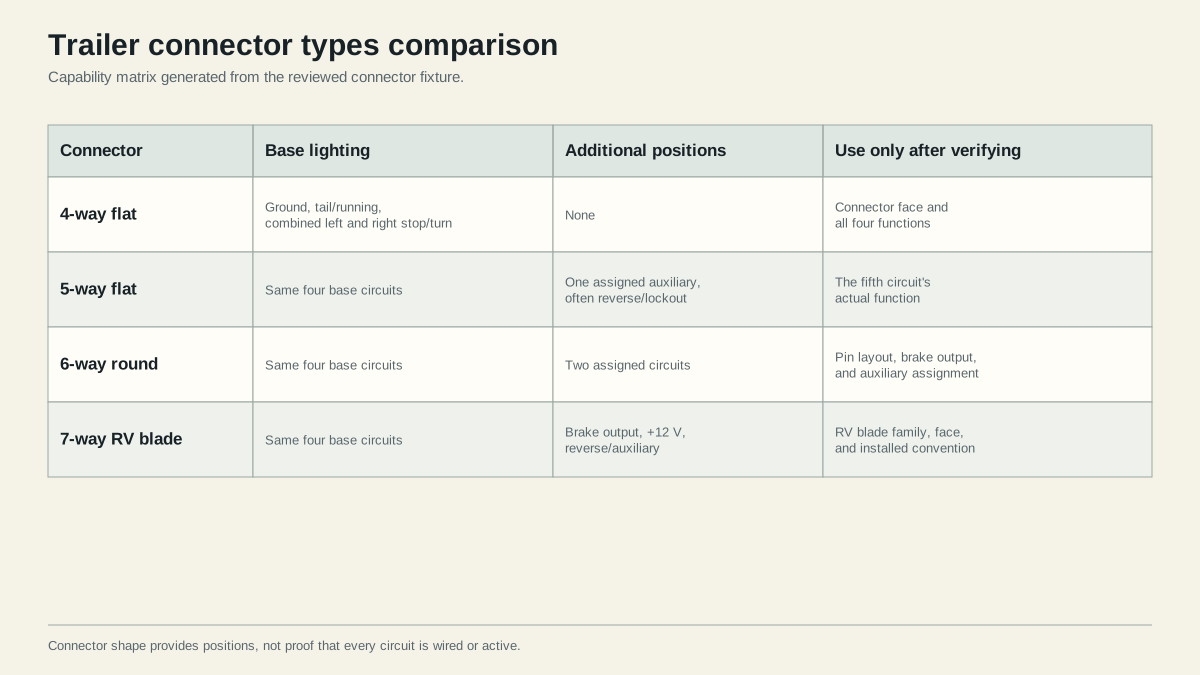
The four base functions need four independent paths because left and right stop/turn signals are separate. Reverse, electric-brake output, and auxiliary power each need another independently assigned position. The CURT wiring reference also distinguishes traditional and newer color conventions, which is why function testing outranks color matching.
Count functions before choosing a body
Ask these questions in order:
- Does the trailer need only running, left stop/turn, and right stop/turn lighting plus ground?
- Does it use a reverse-controlled function such as reverse lamps or a product-specified lockout?
- Does it have electric service brakes that require controller output?
- Does it need an auxiliary-power or charging circuit?
- Are there other assigned circuits documented by the trailer manufacturer?
If the answer to the first question is yes and all others are no, a matched 4-way normally has the needed capacity. One extra verified function can fit a 5-way. Multiple extras often make a matched 7-way RV blade the clearer path, but a 6-way may be appropriate when both ends and every assignment are documented.
Choose a connector or adapter path
- Use a 4-way when the trailer needs only the four base lighting and return circuits.
- Consider a 5-way when exactly one verified extra circuit is required.
- Use a verified 6-way assignment or a matched 7-way system when electric brakes or auxiliary power are present.
- Use the connector selector when the required circuits are known but the connector family is not.
- Use the 4-way to 7-way adapter guide when the vehicle already has a 4-way and the trailer has a 7-way plug.
An adapter can change the interface and pass circuits that already exist. It cannot create brake-controller output, fused auxiliary power, or reverse input.
Use cases, not trailer size, to choose
| Trailer system | Circuits beyond base lighting | Practical connector question |
|---|---|---|
| Small lighting-only utility trailer | None | Is a matched 4-way installed and sound? |
| Boat trailer with reverse lockout | One | Is the fifth circuit assigned and supported at both ends? |
| Trailer with electric brakes | Brake output, often additional functions | Does the vehicle have a compatible controller and enough verified positions? |
| Camper or equipment trailer with brakes and auxiliary needs | Brake, auxiliary, reverse or other assigned use | Are all 7-way functions documented, protected, and tested? |
This is why “What plug fits?” and “What functions work?” are separate questions. An adapter may solve the first while leaving the second unresolved.
Verify orientation and assignments before connecting
Open the correct 4-way pinout or 7-way RV blade pinout, then verify the connector face shown. Test the tow-vehicle output one function at a time before connecting the trailer. On the trailer, trace the same function through the plug, harness, load, and return path.
Use a simple handoff record when installing, repairing, or borrowing a trailer: connector family, view used, each verified position, test method, intentionally unused positions, and the documents that control brake or auxiliary circuits. That record is more useful than a color list because it describes the installed system.
Stop if the observed function conflicts with the diagram, the housing cannot be identified, terminals are damaged, or a required circuit is absent. The installed vehicle, connector, brake-controller, and trailer manuals take precedence over a general reference.
Sources
Last verified: August 25, 2026.